There is always much to learn from quotes and their historical significance. Read on for a collection of quotes and general history from September 29th – October 5th.
September 29, 2008
“With every year that passes, the more we have to be careful not to forget the causes and consequences of the Great Recession.”
– Sherrod Brown
On September 29, 2008, during the height of the 2008 financial crisis, the Dow Jones Industrial Average fell 777.68 points after the House of Representatives rejected the Emergency Economic Stabilization Act of 2008. Four days later, on October 3rd, Congress passed the Act and created the $700 billion Troubled Asset Relief Program (TARP). The crisis led to a global economic downturn, now known as the Great Recession, lasting from December 2007 to June 2009. Often considered the second-worst economic downturn of all time, behind only the Great Depression, we’d do well to remember the consequences felt then after the long period of growth we’ve experienced recently.
September 30, 1935
“The building of the Hoover Dam belongs to the sagas of the daring.”
– Oskar J.W. Hansen
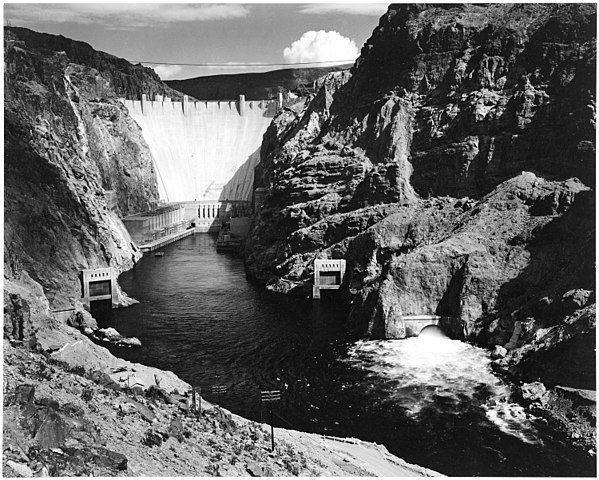
The Hoover Dam was dedicated by President Franklin D. Roosevelt on September 30, 1935. Situated on the Colorado River between Nevada and Arizona, construction began in 1931 and officially concluded on March 1, 1936. Originally called the Boulder Dam, a campaign to rename the dam for President Herbert Hoover ended successfully in 1947 with a joint resolution of Congress. In addition to flood control and creating the Lake Mead reservoir, the Hoover Dam is a hydroelectric plant with a maximum capacity of over 2 gigawatts. The Hoover Dam remains in operation today and has become a major tourist attraction with over a million people visiting each year.
October 1, 1946
“The Nuremberg trials of Nazi leaders, in open court before an international tribunal, had a profound long-term effect in bringing Germans back to democracy and humanity.”
– Anthony Lewis
The Nuremberg trials came to an end on October 1, 1946, with the sentencing of 24 prominent Nazi leaders. Of these, 12 were sentenced to death, 7 received prison time, and the remaining 5 were acquitted. Many other Nazi leaders, including Adolf Hitler himself, committed suicide to avoid capture and thus were never tried. The trials also resulted in the definition of what constitutes a war crime, known as the Nuremberg principles. Furthermore, the trials led to the establishment of a permanent International Criminal Court and marked the first mention of genocide in international law.
October 2, 1967
“Where you see wrong or inequality or injustice, speak out, because this is your country. This is your democracy. Make it. Protect it. Pass it on.”
– Thurgood Marshall
Thurgood Marshall was sworn in as the first African-American Associate Justice of the Supreme Court on October 2, 1967. Prior to Marshall’s first judicial appointment to the United States Court of Appeals for the Second Circuit in 1961, he argued several cases before the Supreme Court. Many involving civil rights, his cases included Smith v. Allwright, Shelley v. Kraemer, and Brown v. Board of Education. After Associate Justice Tom C. Clark retired, President Lyndon B. Johnson successfully nominated Marshall to succeed him. Marshall served on the Supreme Court until his retirement in 1991 and was succeeded by Clarence Thomas.
October 3, 1995
“I’ve been very clear. I won. I didn’t commit the crime.”
– O. J. Simpson
On October 3, 1995, the jury issued a verdict of “not guilty” in the O.J. Simpson murder case regarding the deaths of his ex-wife, Nicole Brown Simpson, and her friend Ron Goldman. As one of the most widely publicized trials in history, it is often characterized as the trial of the century. Public interest was initially captured on June 17, 1994, during live coverage of the low-speed police chase leading to Simpson’s arrest. After an eleven-month trial, an estimated 100 million people tuned in to hear the verdict. Reaction to the verdict was split along racial lines with most African Americans agreeing with the “not guilty” verdict, while most whites and Hispanics disagreed.
Following O.J. Simpson’s acquittal, no further arrests were made and the case remains unsolved. However, a subsequent wrongful death civil lawsuit found Simpson liable and ordered him to pay $33.5 million in damages to the Goldman family. Strangely enough, in 2008 on the same date of October 3, Simpson was found guilty of a Las Vegas robbery and sentenced to 33 years in prison. After serving 9 years, he was released on parole October 1, 2017. Do you believe O.J. Simpson committed the murders?
October 4, 1957
“American greatness was elevated significantly after Sputnik.”
– Buzz Aldrin
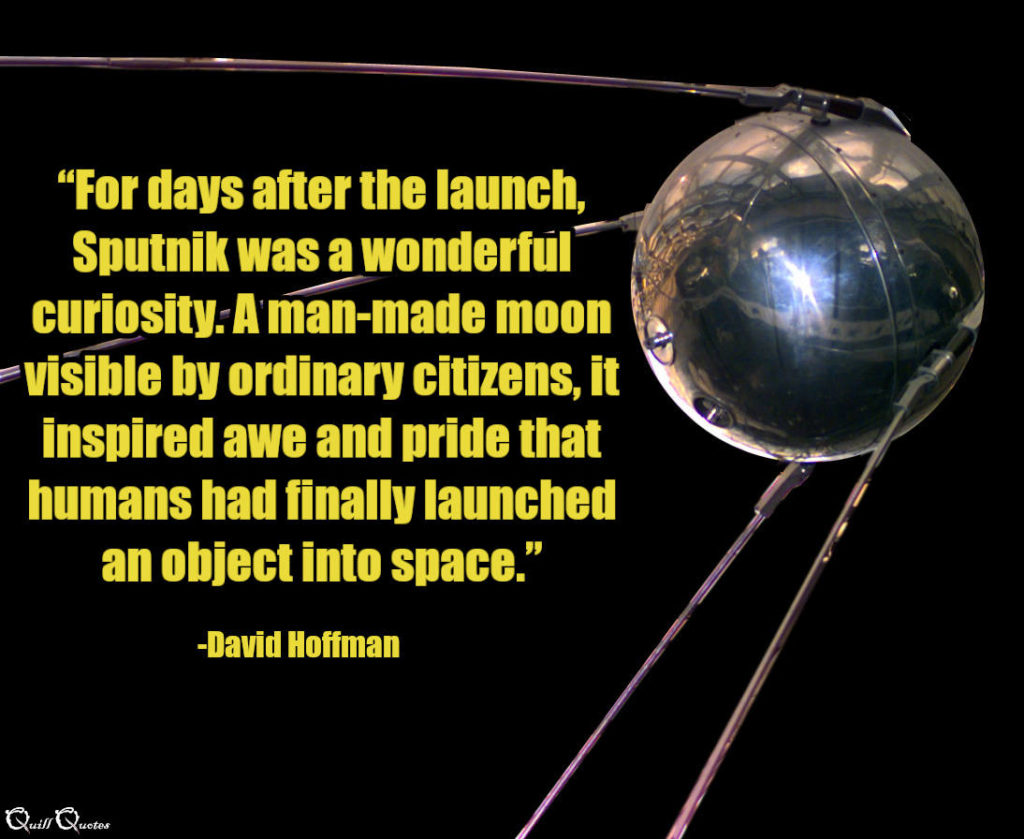
Sputnik 1, the first artificial Earth satellite, was launched by the Soviet Union on October 4, 1957. The satellite orbited for three weeks before its batteries died, broadcasting radio pulses that were easily detectable and monitored throughout the world. The dead satellite continued to orbit for another two months before burning up during atmospheric reentry on January 4, 1958. Sputnik 1’s success shattered the American perception of technological superiority and triggered the Space Race as part of the Cold War. Within months, the United States launched its first satellite, Explorer 1, on January 31, 1958. However, the U.S. continued to lag behind the Soviet Union in space firsts leading President John F. Kennedy to set the famous goal of landing men on the Moon. The U.S. landed the first man on the Moon during Apollo 11 on July 20, 1969, effectively ending the Space Race!
October 5, 1864
Confederate General Samuel G. French: “I have placed the forces under my command in such positions that you are surrounded, and to avoid a needless effusion of blood I call on you to surrender your forces at once, and unconditionally. Five minutes will be allowed you to decide. Should you accede to this, you will be treated in the most honorable manner as prisoners of war.”
Union General John M. Corse: “Your communication demanding surrender of my command I acknowledge receipt of, and respectfully reply that we are prepared for the “needless effusion of blood” whenever it is agreeable to you.”
– William T. Sherman’s memoirs, Volume II Chapter XX
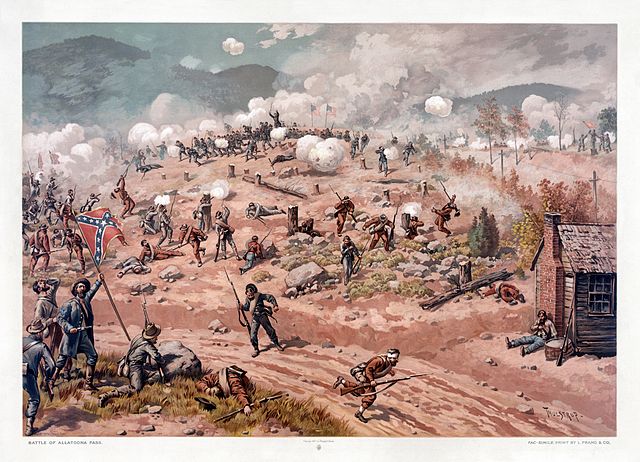
On October 5, 1864, the Battle of Allatoona was fought during the American Civil War. Major General Samuel G. French led more than 3,200 Confederate troops against a Union garrison of a little over 2,000 defending the railroad through Allatoona Pass under Brigadier General John M. Corse. After a couple hours of artillery bombardment, French demanded the Union forces surrender but Corse refused. A Confederate charge ensued and Corse’s men barely managed to hold their position. If not for a mistaken report of approaching Union reinforcements causing French to withdraw, they likely would have been overrun. While the battle was fairly small, there were numerous casualties on both sides, approximately 700 Union and 900 Confederate.
In case you missed last week’s quotes, see History September 22nd – 28th.
To never miss a Quill Quotes post, please subscribe to our free Email Newsletter and follow us on Social Media.
I believe O.J. did kill Nicole and Ron Goldman. I remember thinking the rich and get away with murder. If O.J. wasn’t able to afford Jonny Cochran as defense attorney he would have been convicted. The L.A. police didn’t handle the situation right from the beginning.