There is always much to learn from quotes and their historical significance. Read on for a collection of quotes and general history from August 4th – 10th.
August 4, 1914
“The lamps are going out all over Europe; we shall not see them lit again in our lifetime.”
– Edward Grey
On August 4, 1914, Britain declared war on Germany, entering World War I. Germany had declared war on Belgium the previous day, and Britain was obligated to come to their aid under the 1839 Treaty of London. The onset of WWI happened quite quickly, with much of Europe becoming involved between July 28th and August 12th. Kicked off by Austria-Hungary’s shelling of the Serbian capital of Belgrade and the subsequent mobilization of Russia’s military. However, the fast start quickly slowed to a stalemate as the Allied and Central Powers established their trench lines. While the United States remained neutral until 1917, WWI eventually led to the mobilization of more than 70 million military personnel.
August 5, 1864
“Damn the torpedoes, full speed ahead!”
– Rear Admiral David G. Farragut
The Battle of Mobile Bay was won by the Union fleet on August 5, 1864, during the American Civil War. Led by Rear Admiral David G. Farragut, the battle was characterized by the Union’s bold decision to run through a minefield and engage the Confederate fleet out of range of their shore-based guns. This decision gave rise to the famous quote above, from the original order “Damn the torpedoes! Four bells. Captain Drayton, go ahead! Jouett, full speed!” Once the Confederate Navy was defeated, the 3 forts surrounding Mobile Bay surrendered within days. Thus, the Union gained control of the last important Gulf of Mexico port east of the Mississippi.
August 6, 1945
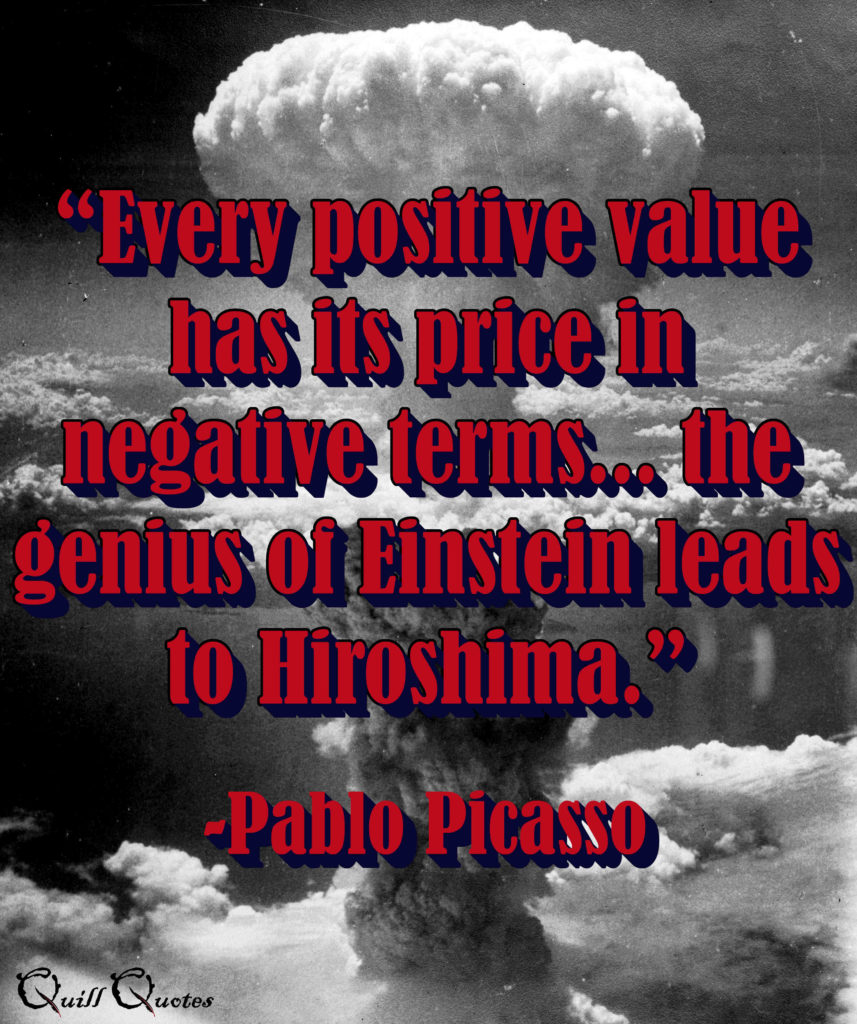
“Nagasaki and Hiroshima remind us to put peace first every day; to work on conflict prevention and resolution, reconciliation, and dialogue; and to tackle the roots of conflict and violence.”
– Antonio Guterres
On August 6, 1945, the atomic bomb “Little Boy” was dropped on Hiroshima, Japan from the US B-29 Superfortress “Enola Gay.” Three days later, August 9th, the “Fat Man” bomb was dropped on Nagasaki, Japan. The two bombings killed an estimated 129,000 to 226,000 people, mostly civilians, and much of each city was destroyed. The necessity and ethical justification for the bombings remains hotly debated to this day. Contrary to popular belief, the decision to use nuclear weapons was not made solely by the United States. As required by the Quebec Agreement, signed in 1943 to coordinate the development of nuclear weapons, the United Kingdom also consented to the bombings. Thankfully, despite the Cold War, these 2 bombings remain the only use of nuclear weapons in armed conflict.
August 7, 1782
“Goddamn it, you’ll never get the Purple Heart hiding in a foxhole! Follow me!”
– Henry Pierson Crowe
George Washington created the Badge of Military Merit, later becoming the Purple Heart, on August 7, 1782. The Purple Heart is the oldest military award still given to U.S. military members and is awarded to those wounded or killed in action. Washington himself only awarded the Badge of Military Merit to three Revolutionary War soldiers, but authorized officers to issue them as they saw fit. While the award continued to be issued by officers, it was not officially sanctioned again until after World War I. On the 200th anniversary of George Washington’s birth, February 22, 1932, the first official Purple Hearts were announced by the War Department.
August 8, 1963
“The fascination for the Great Train Robbery has never diminished.”
– Luke Evans
On August 8, 1963, the Great Train Robbery of £2.6 million from a Royal Mail train occurred in England. A 16-man gang used the lineside signals to stop the train at Bridego Railway Bridge, between Glasgow and London, to raid the train. The robbery was masterminded by Bruce Reynolds based on information from an inside man, known as “The Ulsterman.” The police were able to track the gang to a hideout at Leatherslade Farm, where incriminating evidence led to the arrest of most of the members. Although most of the gang was caught, the stolen money was never recovered and would be worth an estimated £53.5 million ($65 million) today!
August 9, 1974
“You must pursue this investigation of Watergate even if it leads to the president. I’m innocent. You’ve got to believe I’m innocent. If you don’t, take my job.”
– Richard M. Nixon
President Richard Nixon resigned on August 9, 1974, facing almost certain impeachment over the Watergate scandal. The burglary of the Democratic National Committee (DNC) Headquarters at the Watergate office complex in 1972 led to the discovery of many abuses of power by the Nixon administration. These abuses included recording many conversations which revealed the attempted cover-up activities. Following his resignation, the only one in U.S. Presidential history, Nixon was controversially pardoned by his successor, Gerald Ford. Watergate and the suffix “-gate” have since become synonymous with scandal, particularly in the United States.
August 10, 1675
“The soul without imagination is what an observatory would be without a telescope.”
– Henry Ward Beecher
On August 10, 1675, the foundation stone was laid for the Royal Observatory in Greenwich, London. King Charles II commissioned the observatory and created the position of Astronomer Royal for “perfecting the art of navigation.” The Royal Observatory is also known as “Flamsteed House”, after the first Astronomer Royal, John Flamsteed. Crucial to the history of astronomy and navigation, the Royal Observatory has the International Astronomical Union (IAU) observatory code of 000 and is now predominantly a museum. The site is best known due to the prime meridian passing through it, lending its name to Greenwich Mean Time.
Which is your favorite quote/event from this week? Let me know in the comments!
In case you missed last week’s quotes, see History July 28th – August 3rd.
To never miss a Quill Quotes post, please subscribe to our free Email Newsletter and follow us on Social Media.
Leave a Reply